

Goddess Fish Promotions Presents
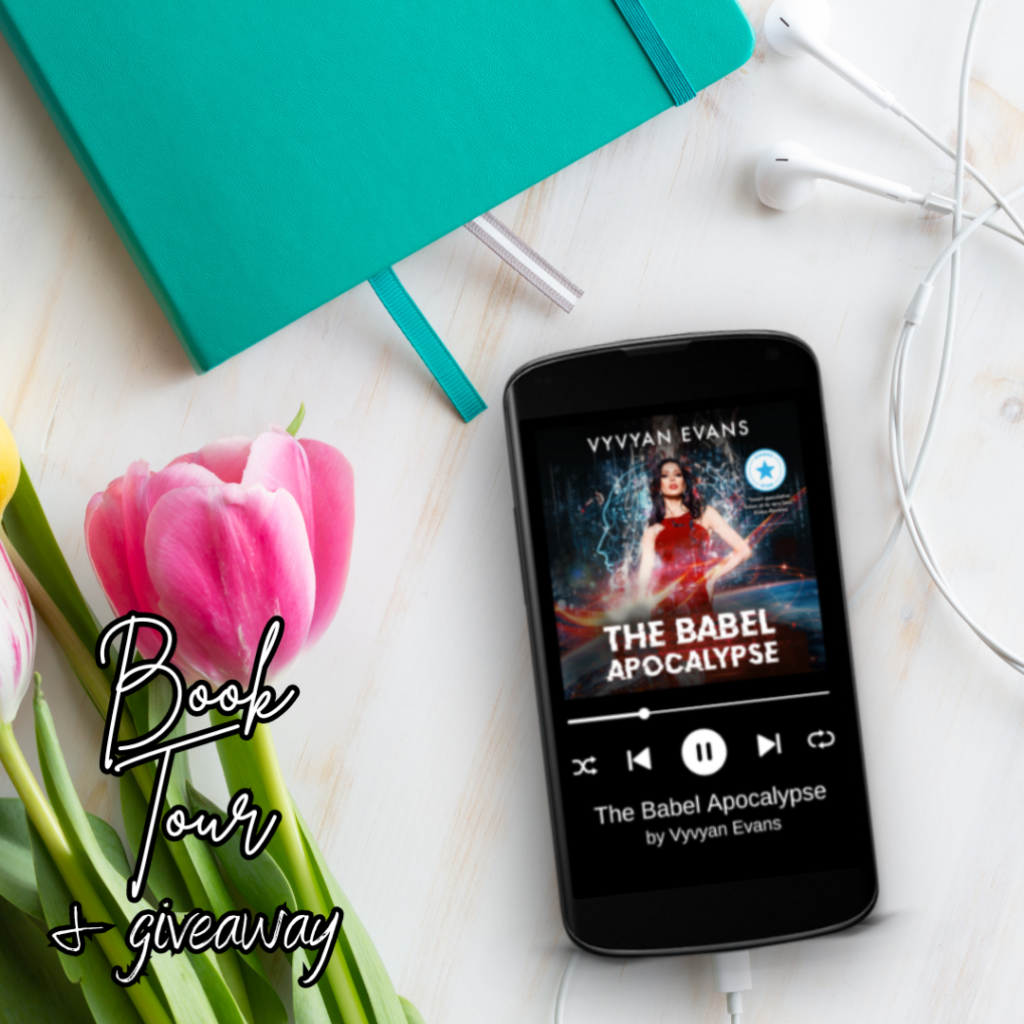
The Babel Apocalypse (Audiobook)
by Vyvyan Evans
A randomly drawn winner will receive a copy of the audiobook – Enter Below


Language is no longer learned, but streamed to neural implants regulated by lang-laws. Those who can’t afford monthly language streaming services are feral, living on the fringes of society. Big tech corporations control language, the world’s most valuable commodity.
But when a massive cyberattack causes a global language outage, catastrophe looms.
Europol detective Emyr Morgan is assigned to the case. Suspect number one is Professor Ebba Black, the last native speaker of language in the automated world, and leader of the Babel cyberterrorist organization. But Emyr soon learns that in a world of corporate power, where those who control language control everything, all is not as it seems. After all, if the mysterious Ebba Black is to blame, why is the Russian Federation being framed for an outage it claims no responsibility for? And why is Ebba now a target for assassination?
As he and Ebba collide, Emyr faces an existential dilemma between loyalty and betrayal, when everything he once believed in is called into question. To prevent the imminent collapse of civilization and a deadly war between the great federations, he must figure out friend from foe—his life depends on it.
And with the odds stacked against him, he must find a way to stop the Babel Apocalypse.

The future of tech/AI in language
The Babel Apocalypse was conceived as a warning, given the advent of smart AI and neuro-prosthetic technology, that, in the near future might render language learning obsolete—language is the hallmark of what it means to be human. Hence, when we lose language, we all lose. The Babel Apocalypse presents an apocalyptic event, in the near future, in which when language is no longer learned but streamed to neural implants, making human communication entirely dependent on big tech corporations.
The mouthpiece for the warning, in the novel, comes in the form of Professor Ebba Black, the last native speaker of language in the automated world. In her words: “They who control language control everything.” And within a landscape where entire populations have given up on language learning, for reasons of convenience, and hence must lease it back for monthly streaming subs, then these populations really are entirely dependent on big tech.
The book’s warning comes in several forms, given language streaming technology would have significant societal, ethical and civil liberty implications.
The first warning relates to the consequences for language itself. And that is, in just one generation there would no longer be any native speakers of language left—The Babel Apocalypse imagines a near future in which language is streamed from internet in space, direct to neural implants; hence, there could be no going back to how it was before.
This entails that individuals become constrained by decisions made by big tech and governments, in terms of words and lexical choice. As one example, imagine a particular state that outlaws abortion under all circumstances. Such a government might then proscribe the word “abortion” itself. Hence, say in the US, someone might stream English and not be able to describe the concept, using the word. This, in effect, also outlaws the very concept itself.
There would then be the Kafkaesque situation whereby in another English-speaking territory, where abortion remains legal, language streaming providers censor the word in one state, but not in another.
But this kind of potential for censorship of thought, by permanently cancelling words, might also lead to a situation where autocratic regimes can abuse the technology for their own ends. The concerns are perhaps obvious, and even worse than imagined in George Orwell’s Nineteen Eighty-Four. Thought itself can be controlled at a stroke, for entire populations, by limiting freedom of expression in language.
In terms of population registration, this would become a de facto consequence of language streaming technology. A language chip would be assigned a unique serial number, encoded in metadata every few seconds as the individual’s language chip connects and communicates with the language streaming servers (via the ear implant transceiver). This means that every individual is instantly identifiable 24/7, by virtue of being linked to internet-in-space language servers.
What this means, in practical terms, is that the concept of privacy is gone forever. Everyone’s location, whom they interact with, is identifiable; and with permanent records stored on file, this ensures that everyone’s lives are being recorded in real time, providing a ‘forever record’ of where they have ever been.
While such technology would inevitably reduce crime, it would come at a huge cost in terms of civil liberties. And it obviously means that overreach by the state is a significant danger, given how easy it would be for governments to spy on all its citizens all the time.
And of course, technology that makes most people in the world wholly dependent on big tech is at risk of exactly the global disaster predicted in The Babel Apocalypse. A global language outage, in such a future, should be viewed very much as a warning, and certainly not a roadmap for overreach by big tech and a big state.

Overall: 5 out of 5
Narration: 5 out of 5
Story: 5 out of 5
Overall: Great story, with excellent narration that brought it to life.
Narration: Damron did a great job of bringing the story to life. It was easy to distinguish the different characters, which is big for me when listening to audiobooks. Cadence was perfect, and it didn’t feel like the book was being read so slowly/quickly that it was hard for me to follow. Recording quality was excellent, the audio was clear and never sounded muffled.
Story: The premise of this book immediately intrigued me – it’s a terrifying prospect, our main means of communication no longer being learned but simply dropped into our brains by neural implants…as long as you can afford it. If you really stop to think about it, language drives our lives – spoken, written, signed. I have to applaud Evans for doing an excellent job pulling off such a unique premise. None of the plot felt forced, and the characters had plenty of depth. I loved Emyr from the start, he’s hard not to like, and his character journey from cover to cover is something you don’t want to miss. Ebba I was on the fence about at first, but she’s very well-written, and if nothing else you can’t help but admire her. I will warn you – this book has more twists than a corkscrew, and just when you think what’s going to happen next you’re surprised. I cannot wait to see what’s in store for us next from this author!

It wasn’t her cold beauty that marked out Ebba Black as unique—her chilling looks, as she called them—although her looks invariably made an impression on all who met her. Rather, it was the fact that she was the last nate in the automated world. That made her famous. Undoubtedly she was celebrated for other things too—Ebba Black the Babelist, the heiress, the conspiracy theorist, the charismatic professor. Maybe even the oddity. After all, Ebba was the last speaker of languages that would die with her. With Elias’s passing five years prior, she had no one left to speak them with. And Ebba Black would not marry. Commitment of that sort wasn’t her thing, and she would certainly never have children. You could say she wasn’t the maternal type.
Ebba knew she was unique in other, ineffable ways, too. For one, she listed things to herself, silently, in her head. Reasons to know me. Reasons not to know me. Reasons to hate me, to admire me. But not reasons to love me. Never that. That was forbidden. Ebba never allowed anyone to get that close.
Sometimes Ebba even indulged in one of her trademark waspish grins. To no one in particular, while she mentally scrolled through one list: reasons to kill. The list with the names. Her list of lists. The grin was the only outward sign she was performing a mental stock-take. It wasn’t good to be on that particular list. Ebba Black was neither the forgiving nor the tolerant type.


Dr. Vyvyan Evans is a native of Chester, England. He holds a PhD in linguistics from Georgetown University, Washington, D.C., and is a Professor of Linguistics. He has published numerous acclaimed popular science and technical books on language and linguistics. His popular science essays and articles have appeared in numerous venues including ‘The Guardian’, ‘Psychology Today’, ‘New York Post’, ‘New Scientist’, ‘Newsweek’ and ‘The New Republic’. His award-winning writing focuses, in one way or another, on the nature of language and mind, the impact of technology on language, and the future of communication. His science fiction work explores the status of language and digital communication technology as potential weapons of mass destruction.

Website | Facebook | Instagram | Twitter | YouTube

Follow the tour here
The more posts you comment on, the more entries you get!